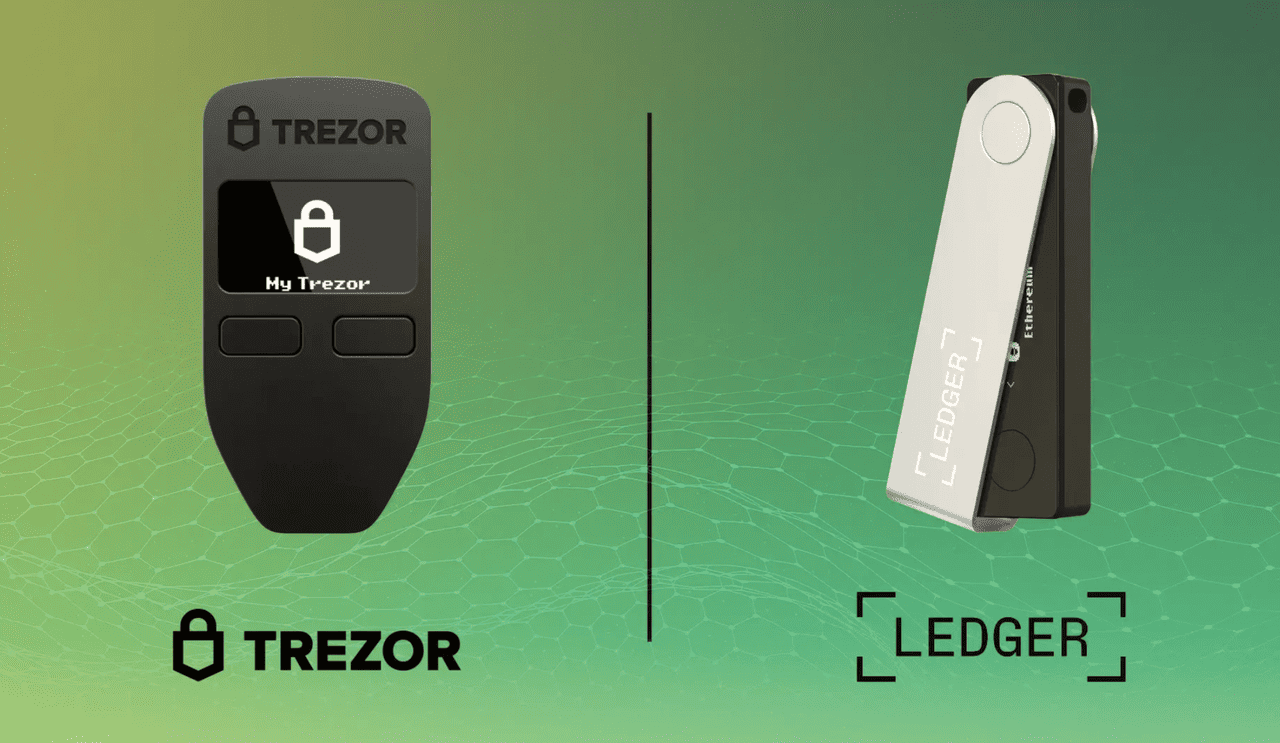
Ledger vs Trezor 2026: Which Cold Wallet Should You Buy
Ledger and Trezor are the two most trusted hardware wallet brands in 2026, but they are built on different philosophies. One is closed source with a broader ecosystem. The other is fully open source with a smaller but more transparent footprint. Here is an honest breakdown of which one fits your situation.
TL;DR: Ledger and Trezor remain the two dominant hardware wallet brands in 2026. Ledger supports over 5,500 cryptocurrencies, offers Bluetooth connectivity on its Nano X, Flex, and Stax models, and runs a closed source secure element with isolated app environments. Trezor is fully open source across both hardware and firmware, supports around 1,400 cryptocurrencies, and its Safe 5 model offers Shamir Backup for splitting recovery seeds across multiple shares. Entry models from both brands cost around 59 to 79 dollars. MediaCrypto recommendation: Ledger Nano X at 149 dollars is the better fit for most people in 2026 because of its broader coin support and mobile app access. Trezor is the right choice specifically for people who want fully open source firmware they can independently verify.
If you have spent any time researching how to store crypto safely, you have run into this question. Ledger or Trezor. The two names come up in almost every guide, every YouTube video, every forum thread about hardware wallets, and for good reason. They are the two most established brands in the space and both have years of track record behind them.
The honest answer is that both are good. Neither is a bad choice. But they are built around different priorities, and which one is right for you depends on what you actually care about.
The Core Philosophical Difference
Ledger, based in France, builds its devices around a proprietary secure element chip and a custom operating system where each cryptocurrency app runs in its own isolated environment. If a vulnerability is found in one app, it cannot automatically spread to compromise the rest of the device. The tradeoff is that Ledger's secure element firmware is closed source, meaning you cannot independently verify exactly what is running on the chip that holds your keys.
Trezor, made by SatoshiLabs in the Czech Republic, takes the opposite approach. Both its hardware design and firmware are fully open source. Anyone with the technical skill can review the code that runs on a Trezor device. This is not a small detail for a certain type of crypto user. For people who got into crypto specifically because they did not want to trust closed systems, Trezor's transparency is the entire point.
Neither approach is objectively wrong. One prioritizes a hardened, isolated architecture you cannot inspect yourself. The other prioritizes a fully inspectable architecture that relies more on community auditing. Pick based on which tradeoff matches how you think about trust.
What Each Lineup Actually Costs
Ledger's current lineup spans four devices. The Nano S Plus sits at the entry level around 79 dollars with a small screen and USB only connectivity. The Nano X at 149 dollars adds Bluetooth, letting you manage your wallet from a phone without a cable. The Flex at 249 dollars and the Stax at 399 dollars are the premium tier, both with larger touchscreens and a more polished interface aimed at users who want their hardware wallet to feel like a modern device rather than a USB stick with two buttons.
Trezor's lineup is smaller. The Safe 3 at 79 dollars is the direct competitor to the Nano S Plus, USB only with a basic screen. The Safe 5 at 169 dollars is Trezor's flagship, adding a color touchscreen and Shamir Backup support. Trezor does not currently offer a Bluetooth option at any price point, which is a deliberate choice rather than an oversight. Removing wireless connectivity removes an entire category of potential attack surface.
At the entry level, the price difference is negligible, 79 dollars buys a capable device from either brand. The meaningful price decisions happen at the mid tier, where Ledger's Nano X at 149 dollars competes more against Trezor's Safe 5 at 169 dollars than against Trezor's cheaper Safe 3.
Coin Support Is Not Close
If you hold a wide variety of assets, this is probably the single most decisive factor. Ledger supports more than 5,500 cryptocurrencies and tokens. Trezor supports approximately 1,400.
For someone holding Bitcoin, Ethereum, and a handful of major altcoins, both wallets cover you completely and this difference does not matter at all. But if your portfolio includes smaller cap tokens, newer chains, or assets from emerging ecosystems, there is a real chance Trezor simply does not have an app for it yet while Ledger does. Anyone holding a meaningfully diverse altcoin portfolio should check Trezor's supported asset list carefully before buying, since this is the one area where the gap between the two brands is large rather than marginal.
The Mobile Question
Ledger's Nano X, Flex, and Stax all support Bluetooth, meaning you can connect to the Ledger Live app on iOS or Android and manage your portfolio, send and receive funds, and interact with supported services directly from your phone. Trezor has no equivalent. Trezor management happens through a desktop browser connection via USB, full stop.
If you primarily manage crypto from your phone, this is a significant practical difference, not a minor one. If you primarily use a desktop or laptop and only occasionally need mobile access, it matters much less. Some security-focused users actually view Trezor's USB-only requirement as a feature rather than a limitation, since it removes Bluetooth entirely as a potential attack vector, however small that risk might be in practice.
Backup and Recovery Approaches
Both Ledger and Trezor use the standard 24 word recovery seed that has become the industry norm. Where they diverge is in advanced backup options.
Trezor's Safe 5 supports Shamir Backup, which splits your recovery seed into multiple shares, for example five shares where any three are needed to reconstruct the seed. This means you can distribute shares across different physical locations, and losing access to one or two shares does not mean losing your funds, while someone finding a single share gains nothing usable on its own. This is a meaningfully more sophisticated backup strategy than a single 24 word phrase written on one piece of paper or metal.
Ledger relies on the standard 24 word phrase, with an optional subscription service called Ledger Recover that splits your seed and stores encrypted fragments with third party custodians for a monthly fee. This feature has been controversial in the community precisely because it introduces a third party into what was previously a fully self-custodial backup model, even though the fragments are encrypted and the service is opt-in. If you want Shamir-style seed splitting without any third party subscription involved, Trezor's Safe 5 has it built in at no extra cost.
The Buy Direct Rule Applies to Both
Regardless of which brand you choose, this rule has no exceptions. Buy directly from ledger.com or trezor.io. Never from Amazon, eBay, or any third party marketplace, even ones that look official. Devices purchased through unofficial channels have been intercepted and tampered with before reaching buyers, with attackers pre-loading compromised firmware or seed phrases designed to give them access to funds once the victim sets up the device. The price difference between buying direct and buying through a marketplace is rarely more than a few dollars. The risk difference is total loss of funds versus none.
MediaCrypto's Recommendation
For most people reading this in 2026, the Ledger Nano X at 149 dollars is the better default choice. The combination of broad coin support covering over 5,500 assets, Bluetooth connectivity for mobile management, and the mature Ledger Live ecosystem covers the needs of the large majority of crypto holders without compromise.
Choose Trezor specifically if open source firmware that you or the community can independently audit is a priority you are not willing to compromise on, or if you specifically want Shamir Backup's seed-splitting capability without any third party subscription. The Trezor Safe 5 at 169 dollars is the model to look at for that use case.
If your budget is tight and you hold mainly Bitcoin, Ethereum, and major altcoins, the entry level options from either brand, the Ledger Nano S Plus or Trezor Safe 3, both around 79 dollars, are genuinely fine choices and a significant security upgrade over leaving meaningful amounts on an exchange.
Whichever you choose, the decision that matters most is not Ledger versus Trezor. It is hardware wallet versus no hardware wallet at all. Both of these companies have spent years building devices specifically to solve the exchange hack and phishing problems that account for most crypto losses. Either one, set up correctly with your seed phrase backed up offline, solves that problem completely.
About the Author
This article was researched and written by the MediaCrypto editorial team. MediaCrypto is a cryptocurrency news and market analysis publication covering Bitcoin, Ethereum, altcoins, regulatory developments, and market trends. Follow our daily analysis on X at @MediaCryptoAI.
Follow us on X: https://x.com/MediaCryptoAI
FAQ — Ledger vs Trezor 2026
Which is better, Ledger or Trezor? Neither is universally better. Ledger offers broader coin support with over 5,500 assets and Bluetooth mobile access, making it the better fit for most users. Trezor offers fully open source firmware and, on the Safe 5, built-in Shamir Backup, making it the better fit for users who prioritize transparency and advanced seed splitting.
How much does a Ledger or Trezor cost? Entry level devices from both brands cost around 79 dollars, the Ledger Nano S Plus and Trezor Safe 3. Mid tier options are the Ledger Nano X at 149 dollars and Trezor Safe 5 at 169 dollars. Ledger's premium Flex and Stax models cost 249 and 399 dollars.
Does Trezor support as many coins as Ledger? No. Ledger supports over 5,500 cryptocurrencies and tokens compared to approximately 1,400 for Trezor. For major assets like Bitcoin, Ethereum, and large altcoins both are fully covered, but Ledger has significantly broader support for smaller cap and newer tokens.
Is Ledger or Trezor safer? Both use strong security architectures. Ledger uses a proprietary secure element chip with isolated app environments. Trezor's newer Safe 3 and Safe 5 models use EAL6+ secure elements while remaining fully open source, allowing independent security audits that Ledger's closed source firmware does not permit.
Should I buy a hardware wallet from Amazon? No. Always buy directly from ledger.com or trezor.io. Devices sold through Amazon, eBay, or other third party marketplaces have been tampered with by attackers before reaching buyers. The small price savings are not worth the risk of total fund loss.
For live crypto prices and market data see read this article
Read also: How to Store Crypto Safely 2026 — read this article
Read also: How to Buy Crypto for Beginners 2026 — read this article
This article is for informational purposes only and does not constitute financial advice. Always do your own research before making investment decisions.