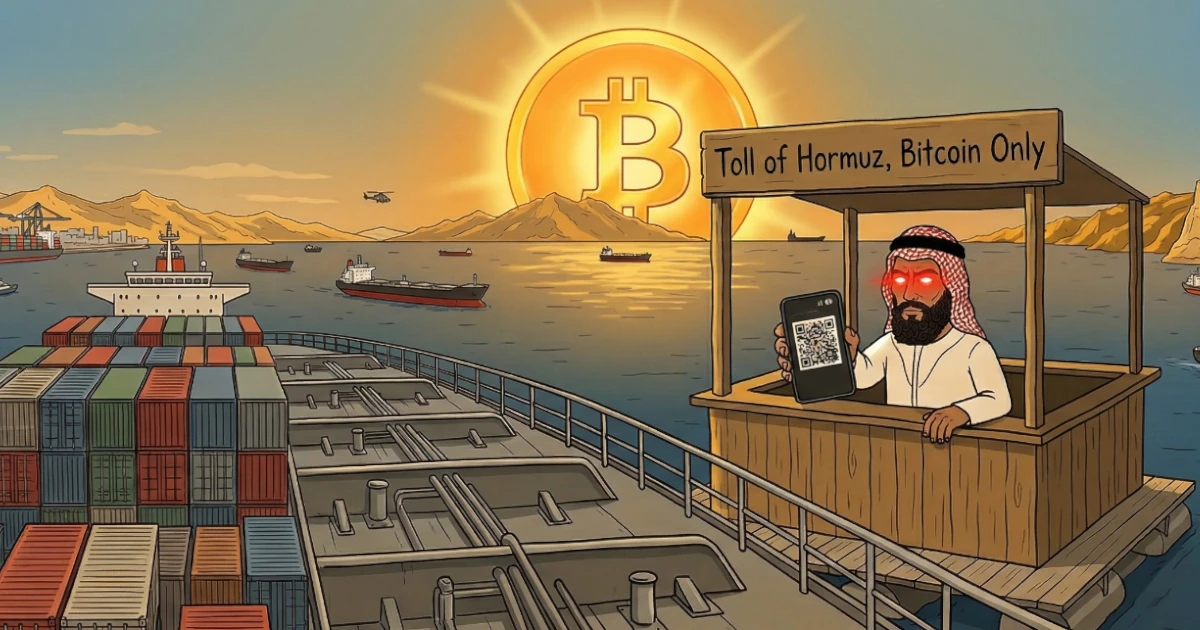
Iran Accepts Bitcoin for Strait of Hormuz Transit: What It Means for Crypto and Global Oil
Iran's IRGC has been charging oil tankers up to $2 million per vessel in Bitcoin and USDT to transit the Strait of Hormuz since mid-March 2026. At current traffic levels the system generates an estimated $600 to $800 million per month. Here is what it means for Bitcoin, the petrodollar system, and global oil markets.
TL;DR: Since mid-March 2026, Iran's Islamic Revolutionary Guard Corps has been charging oil tankers up to $2 million per vessel to transit the Strait of Hormuz, accepting payment in Bitcoin, USDT, and Chinese yuan. The toll runs approximately $1 per barrel of crude cargo. At 21 million barrels of oil transiting daily, public estimates put the system's revenue at $600 to $800 million per month. MediaCrypto analysis: this is the most significant real-world state-level Bitcoin adoption event in 2026 and the most aggressive challenge to the petrodollar system since the 1970s.
Twenty percent of the world's oil supply transits the Strait of Hormuz every single day. Since mid-March 2026, every tanker carrying that cargo has been paying a toll in Bitcoin.
This is not a pilot program or a proposal. It is operational infrastructure that has been running for months, processing billions of dollars in crypto payments, and disrupting the assumptions that the global oil trade has operated on for fifty years. Iran has turned the world's most important maritime chokepoint into a Bitcoin toll booth.
Here is what is actually happening and why it matters beyond the geopolitical headline.
How the System Works
The operational details matter because they reveal the sophistication behind what looks like a simple demand for Bitcoin payments.
Ship operators seeking to transit the Strait of Hormuz must first email Iranian authorities with detailed cargo information: vessel ownership, flag, cargo type, destination, and crew details. Iranian authorities calculate the toll at approximately $1 per barrel of crude cargo. A fully loaded Very Large Crude Carrier hauling 2 million barrels pays $2 million before it clears the waterway.
Once the fee is calculated the ship's crew has seconds to complete the transfer to an Iran-controlled wallet address. The speed requirement is not accidental. It makes real-time interdiction by US Treasury practically impossible. By the time a transaction is flagged and actioned the transfer is already confirmed on the blockchain.
Payment is accepted in Bitcoin, USDT, and Chinese yuan routed through Kunlun Bank via CIPS outside the SWIFT network. Iran formally approved the "Strait of Hormuz Management Plan" on March 30-31, 2026, codifying a system that was already running.
The Scale of What This Represents
The numbers are staggering when you work through them properly.
At 21 million barrels of oil transiting the Strait daily and $1 per barrel, the gross daily intake from oil tankers alone reaches $21 million. That is $630 million per month from crude traffic. Add LNG carriers and multiple analysts have cited $800 million monthly as the upper ceiling.
Chainalysis estimated that IRGC-linked crypto transactions received $7.8 billion in 2025, up from $3.17 billion in 2023. The Hormuz toll system is the most visible application of crypto payment infrastructure that Iran has been building at scale for years. They are not improvising. They built the rails and then deployed them on the world's most strategically important waterway.
The IRGC has also established a dedicated crypto conversion operation on Qeshm Island where digital assets are cycled through various layers before being used to fund domestic imports. The entire system is designed to operate outside dollar-based financial channels with real-time payment verification that requires no correspondent bank.
Why Stablecoins More Than Bitcoin
One detail from the Chainalysis analysis is worth understanding. Iran has historically preferred stablecoins over Bitcoin for high-volume commerce because dollar-backed stablecoins preserve value and provide the liquidity needed at scale. Bitcoin experiences regular price volatility that creates settlement risk on large transactions.
Bitcoin is better suited to scenarios where seizure resistance matters more than price stability, specifically because it has no issuer who can freeze it. The IRGC's choice to accept both reflects a sophisticated understanding of when each is the right tool. Bitcoin for seizure resistance and immediate settlement. USDT for value preservation on larger flows.
The fact that a sanctioned nation state has built operational infrastructure sophisticated enough to make this distinction tells you something important about how far crypto adoption has progressed in adversarial state contexts.
What This Means for the Petrodollar System
The petrodollar system has operated since the 1970s when the United States negotiated with Saudi Arabia to price all global oil sales in US dollars. This created permanent global demand for dollars because every country that imports oil needs dollars to buy it. It is the foundation of American financial dominance.
Iran accepting Bitcoin and yuan for Strait of Hormuz transit is a direct attack on that system. It is the first time a state has used crypto infrastructure as a sovereign revenue mechanism at a major maritime chokepoint. If the pattern expands to other oil producers or other trade flows, the structural demand for dollars that underpins the petrodollar system weakens.
The immediate practical impact is limited. Iran controls the Strait but does not set global oil prices. The dollar remains the dominant global reserve currency. Saudi Arabia and the Gulf states have not changed their pricing denomination.
But the precedent is different from anything that has come before. A sanctioned state has demonstrated that trillion-dollar trade flows can be redirected outside the dollar payment system using crypto infrastructure that is already operational. That demonstration does not go unnoticed by other governments watching.
MediaCrypto Analysis
This story is being covered primarily as a geopolitical development. The crypto angle is being underweighted.
Iran has just provided the clearest proof of concept in history that Bitcoin and stablecoins can function as sovereign payment infrastructure at scale, under sanctions, in real time, for strategic commerce. Not theory. Operational reality generating hundreds of millions of dollars per month.
The long-term implication for Bitcoin is not that Bitcoin becomes a tool for sanctions evasion globally. It is that the demonstrated ability to conduct large-scale commerce outside dollar-based correspondent banking changes the calculus for every government and institution that has been watching from the sidelines.
About the Author
This article was researched and written by the MediaCrypto editorial team. MediaCrypto is a cryptocurrency news and market analysis publication covering Bitcoin, Ethereum, altcoins, regulatory developments, and market trends. Follow our daily analysis on X at @MediaCryptoAI.
Follow us on X: https://x.com/MediaCryptoAI
FAQ — Iran Bitcoin Strait of Hormuz 2026
Is Iran really accepting Bitcoin for Strait of Hormuz transit? Yes. Since mid-March 2026, Iran's IRGC has been charging oil tankers up to $2 million per vessel in Bitcoin, USDT, and Chinese yuan to transit the Strait of Hormuz. Iran's parliament formally approved the Strait of Hormuz Management Plan on March 30-31, 2026, codifying the system.
How much money is Iran making from Bitcoin tolls? At $1 per barrel and 21 million barrels of oil transiting daily, estimates put the system at $21 million per day from crude tankers alone. Monthly estimates range from $600 million to $800 million when LNG carriers are included.
Why is Iran using Bitcoin instead of just dollars? Bitcoin has no issuer who can freeze or seize it, making it resistant to US Treasury sanctions enforcement. USDT is used alongside Bitcoin for larger value preservation. The combination gives Iran both seizure resistance and price stability.
Does this threaten the petrodollar system? It is the most significant challenge to the petrodollar system since the 1970s. Iran has demonstrated that major oil trade flows can operate outside dollar-based correspondent banking. The immediate impact is limited but the precedent is historically significant.
Is this legal under international law? The toll system is disputed under international law. Most maritime law experts argue that Iran cannot unilaterally charge transit fees in international waters. However, enforcement is practically difficult when payments are made in Bitcoin with seconds to complete.
For live crypto prices and market data see read this article
Read also: Bitcoin Price Prediction 2026 Full Year — read this article
Read also: Is the 2026 Crypto Bull Market Over — read this article
This article is for informational purposes only and does not constitute financial advice. Always do your own research before making investment decisions.