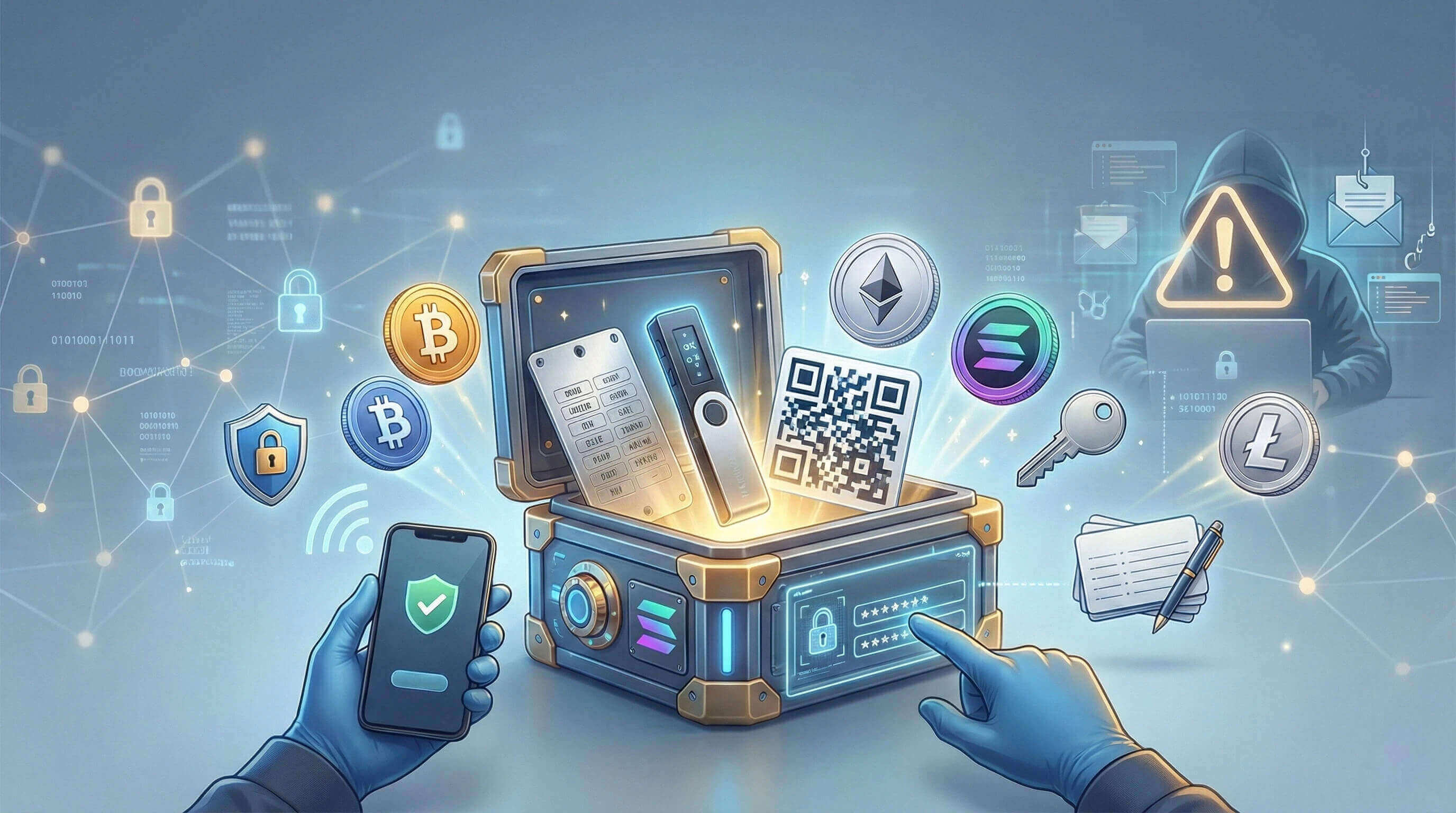
How to Store Crypto Safely in 2026: Complete Guide to Wallets, Cold Storage and Security
Most crypto losses in 2026 are not from market crashes — they are from preventable security failures. Exchange hacks, lost seed phrases, phishing attacks, and SIM swaps have cost investors billions. Here is the complete guide to storing crypto safely in 2026 — from exchange wallets to hardware cold storage.
TL;DR: The safest way to store crypto in 2026 is in a hardware wallet, either a Ledger Nano X or Trezor Model T, with the seed phrase written on metal and stored offline. For amounts under $1,000 a reputable exchange like Binance or Coinbase is acceptable. Never store large amounts on exchanges long-term. Never share your seed phrase with anyone under any circumstances. MediaCrypto security rule: if someone asks for your seed phrase, it is always a scam.
Most crypto losses in 2026 are not from market crashes. They are from mistakes that were completely preventable.
The FTX collapse wiped out $8 billion in customer funds that were sitting on a centralized exchange. The Bitfinex hack in 2016 lost 119,754 Bitcoin, worth over $9 billion at today's prices. Individual investors lose crypto every week to phishing attacks, SIM swaps, and seed phrases stored in the wrong place. None of these losses required a market crash. They required one bad decision.
This guide is about making the right decisions before a bad one costs you.
The One Question That Determines Everything
Every crypto storage decision comes down to a single question: who controls the private keys?
A private key is a long string of numbers and letters that proves ownership of cryptocurrency on the blockchain. If you control your private keys, you own your crypto. If someone else controls them, whether that is an exchange, a custodian, or a third-party wallet, you are trusting them to give you access when you ask for it. That trust is the risk.
This is where the phrase "not your keys, not your coins" comes from. It is not a slogan. It is the operating principle that separates people who kept their crypto through every exchange failure in the last decade from the ones who lost everything.
Custodial storage means a third party holds your keys. When you buy Bitcoin on Binance or Coinbase and leave it there, the exchange holds the keys. You have an account balance shown on a screen, not actual Bitcoin. If that exchange gets hacked, goes bankrupt, or freezes withdrawals, your access depends entirely on their solvency and goodwill.
Non-custodial storage means you hold your own keys. A hardware wallet, a software wallet, or a paper wallet gives you direct ownership. No exchange, no government, no hacker can access your crypto without your private key or seed phrase.
When Leaving Crypto on an Exchange Is Fine
For amounts under $1,000, leaving crypto on a regulated exchange is a reasonable decision. The convenience of quick trading access outweighs the exchange risk at that size. For active traders who buy and sell regularly, keeping trading capital on exchange makes practical sense. For complete beginners, starting with an exchange wallet while you learn is perfectly acceptable.
What matters is which exchange. MediaCrypto recommends Binance for international users and Coinbase for US users. Both are regulated, both have substantial security infrastructure, and both have handled security incidents without permanent user losses.
Anything that promises unusually high yields, exclusive access, or is run by a team you cannot independently verify is a trap. The history of crypto is full of exchanges that looked legitimate until they were not.
Hardware Wallets: The Right Choice for Serious Holdings
A hardware wallet is a small physical device that stores your private keys completely offline. Because the keys never touch the internet they cannot be stolen by hackers, malware, or phishing attacks regardless of how sophisticated those attacks become. Two devices dominate the market in 2026 for good reason.
The Ledger Nano X costs approximately $149 and supports over 5,500 cryptocurrencies. It connects via Bluetooth to your phone and via USB to your computer. The Ledger Live app handles portfolio management, sending and receiving, and staking while your private keys stay on the device and never leave it.
The Trezor Model T costs approximately $219 and is fully open-source, meaning its code has been independently verified by security researchers around the world. Trezor has never had a firmware vulnerability that resulted in private key extraction. For users who want maximum transparency and open-source verification, Trezor is the right choice.
Both generate a seed phrase when you first set them up. If your device is ever lost, stolen, or destroyed, you can recover everything on any compatible hardware wallet using only those words.
One critical rule: only buy Ledger from ledger.com and Trezor from trezor.io. Never from Amazon, eBay, or any third-party seller. Tampered devices have appeared in the market and a hardware wallet that has been modified before you receive it defeats the entire purpose.
Your Seed Phrase Is the Most Important Thing You Own
If you hold significant crypto, your seed phrase is the most valuable piece of information in your possession. It needs to be treated accordingly.
Never store it digitally. Not in a photo. Not in a notes app. Not in an email. Not in any cloud service. A screenshot of your seed phrase in your camera roll is accessible to any app on your phone with photo permissions. Malware specifically targets crypto-related images. Write it down by hand the moment it appears on your device during setup.
Better than paper is metal. Stainless steel seed phrase backup cards from products like Cryptosteel are fireproof, waterproof, and corrosion-resistant. A paper backup destroyed in a house fire means your crypto is gone. A metal backup survives it. For under $50 it is one of the best insurance purchases you can make.
Store the backup in a physically secure location: a safe, a safety deposit box, or somewhere only you know about. If you hold substantial amounts, consider splitting the backup across two locations.
The rule with no exceptions: anyone who asks for your seed phrase is trying to steal your crypto. Not customer support. Not Ledger or Trezor claiming there is an issue with your device. Not a helpful person in a Telegram group. Anyone. Always a scam.
Software Wallets for Active Use
Software wallets, the applications you install on your phone or computer, store your private keys on your device rather than on an exchange. More secure than leaving crypto on an exchange because you hold the keys. Less secure than a hardware wallet because the device is internet-connected.
MetaMask for Ethereum and EVM chains, Phantom for Solana, and Trust Wallet for multi-chain use are the most widely used in 2026. These are the right tools for DeFi activity: interacting with protocols, providing liquidity, using DEXes. Not the right tools for long-term storage of meaningful amounts.
The practical framework for most crypto investors: hardware wallet for long-term holdings, software wallet for active DeFi use. Think of it as a vault and a checking account. Keep only what you need for immediate activity in the software wallet. Move everything else to cold storage.
Five Mistakes That Cost Investors Money Every Week
Leaving large amounts on exchanges long-term. FTX, Mt. Gox, Bitfinex, Cryptopia. The list of exchanges that have failed or been hacked is long. Any amount above $1,000 sitting on an exchange carries a risk that a $150 hardware wallet eliminates completely.
Storing the seed phrase on a phone or computer. A screenshot in your camera roll can be accessed by malicious apps, cloud syncing, or anyone who gets into your device. Paper or metal, stored physically, is the only safe option.
Reusing passwords across accounts. If your exchange password matches your email password and your email is compromised, your exchange account is compromised. Use a unique password for every crypto account and a password manager to keep track of them.
Clicking links in emails and social media messages. The most common 2026 attack involves fake websites built to look exactly like Binance, Coinbase, MetaMask, or Ledger that capture your credentials when you enter them. Bookmark the real URLs and only use bookmarks. Never click links from messages.
Using SMS for two-factor authentication. A SIM swap attack convinces your mobile carrier to transfer your phone number to a SIM the attacker controls. They then receive your 2FA codes and access your accounts. Use Google Authenticator or Authy instead and add a PIN to your mobile carrier account to make SIM swaps harder.
Setting Up Your Hardware Wallet
Buy directly from the manufacturer. Verify the packaging is sealed and unmodified when it arrives. Return it immediately if anything looks wrong.
Initialize the device following the setup instructions. It generates your seed phrase during this process. Write down every word in exact order. Verify by re-entering them when prompted. Store the backup offline in a secure physical location. Never photograph it.
Once set up, transfer crypto to your hardware wallet address. Always send a small test transaction first before moving large amounts. Verify it arrived before sending the rest.
FAQ — How to Store Crypto Safely 2026
What is the safest way to store crypto in 2026? A hardware wallet, either Ledger Nano X or Trezor Model T, with the seed phrase backed up on metal and stored in a physically secure offline location. This eliminates exchange hack risk, malware risk, and phishing risk simultaneously.
Is it safe to leave crypto on Binance or Coinbase? For amounts under $1,000 and for active traders, yes. Both are regulated exchanges with substantial security infrastructure. For amounts above $1,000 held long-term, move to a hardware wallet.
What happens if I lose my hardware wallet? If you have your seed phrase you can recover everything on any compatible hardware wallet by entering it during setup. The seed phrase controls the crypto. The physical device is replaceable.
What is a seed phrase and why does it matter? A seed phrase is 12 or 24 random words generated when you set up a non-custodial wallet. It is the master key to all crypto in that wallet. Anyone with it has complete access to your funds. Never share it and never store it digitally.
Can crypto in a hardware wallet be hacked remotely? No. Private keys in a properly set up hardware wallet never connect to the internet. Remote hacking is not possible. The only ways to access the funds are physical possession of the device and the PIN, or access to the seed phrase.
For live crypto prices and market data see read this article
Read also: How to Buy Bitcoin in 2026 — read this article
Read also: What is Bitcoin and How Does It Work — read this article
This article is for informational purposes only and does not constitute financial advice. Always do your own research before making investment decisions.