How to Buy Bitcoin in 2026: Complete Beginner's Guide to BTC — Step by Step
Buying Bitcoin in 2026 takes less than 10 minutes and starts with as little as $10. Here is the complete beginner's guide to buying BTC safely — including which exchanges to use, how to store it, and how to avoid the most common mistakes that cost new investors money.
TL;DR: Buying Bitcoin in 2026 takes less than 10 minutes. Choose a regulated exchange — Binance, Coinbase, or Kraken — create an account, verify your identity, deposit funds, and buy BTC. For amounts under $1,000 keep it on the exchange. For larger amounts transfer to a hardware wallet like Ledger or Trezor. MediaCrypto recommends Binance for most users outside the US due to low fees and deep liquidity. Never buy Bitcoin from someone who DMs you on social media — that is always a scam.
Bitcoin is now trading near $77,000 and is the most widely held cryptocurrency in the world with over 50 million wallets holding BTC. Despite its mainstream status millions of people still do not know how to buy it safely. This guide covers everything a beginner needs to buy their first Bitcoin in 2026 — from choosing an exchange to storing it securely — in plain language with no jargon.
What Is Bitcoin and Why Do People Buy It?
Bitcoin is a digital currency with a fixed supply of 21 million coins that cannot be inflated, seized, or controlled by any government or central bank. It was created in 2009 by an anonymous developer known as Satoshi Nakamoto and has grown from worthless to a $1.5 trillion asset over 15 years.
People buy Bitcoin for three main reasons in 2026. First as a store of value — Bitcoin is often called "digital gold" because like gold it has a fixed supply and cannot be printed. Second as a speculative investment — Bitcoin has been the best performing asset of the last decade and many investors buy it expecting price appreciation. Third as a hedge against currency debasement — in countries with high inflation and currency weakness, Bitcoin has become a practical alternative to holding local currency.
Step 1 — Choose the Right Exchange
The exchange is where you buy, sell, and store Bitcoin. Choosing the right one is the most important decision a beginner makes. Here are the best exchanges for buying Bitcoin in 2026:
Binance is the world's largest cryptocurrency exchange by trading volume and MediaCrypto's top recommendation for most users outside the United States. Binance offers some of the lowest trading fees in the industry — as low as 0.1% on spot trades — supports over 350 cryptocurrencies, and has processed trillions in volume since its founding in 2017. Binance is regulated in multiple jurisdictions and has never suffered a major security breach that resulted in permanent user losses. Sign up for Binance here: https://www.binance.com/register?ref=KXMN4JF5
Coinbase is the best exchange for US-based beginners. It is publicly listed on Nasdaq, FDIC-insured for cash balances up to $250,000, and is the most trusted exchange among US retail investors. Fees are higher than Binance — typically 0.6% per trade — but the interface is the simplest in the industry and customer support is the best among major exchanges.
Kraken is the best option for users who prioritize security and regulatory compliance above all else. Founded in 2011 it is the oldest continuously operating major exchange and has never been hacked. Kraken supports bank wire transfers in most countries and has strong support for European users via SEPA transfers.
Step 2 — Create and Verify Your Account
Every legitimate exchange requires identity verification — known as KYC (Know Your Customer). This is a legal requirement, not optional. Anyone offering to sell you Bitcoin without KYC is operating illegally and is likely a scam.
The verification process takes 10 to 30 minutes and requires a government-issued ID — passport or national ID card — and in most cases a selfie photo. Once verified your account is fully functional for buying and selling.
Never skip this step. Exchanges that do not require KYC cannot legally operate in most countries and provide no recourse if something goes wrong.
Step 3 — Deposit Funds
Once your account is verified you need to deposit money to buy Bitcoin. Most exchanges support multiple deposit methods:
Bank transfer is the cheapest method — typically free or under $1 fee — but takes 1 to 3 business days to clear. This is the best option for larger purchases above $500.
Debit or credit card provides instant access to funds but charges higher fees — typically 1.5% to 3.5% above the exchange rate. Use this for smaller first purchases where speed matters more than cost.
Crypto transfer — if you already hold USDT, USDC, or other stablecoins you can deposit them directly and use them to buy Bitcoin with zero conversion fees on most exchanges.
Step 4 — Buy Bitcoin
Once your funds are deposited buying Bitcoin takes under 60 seconds. On most exchanges the process is:
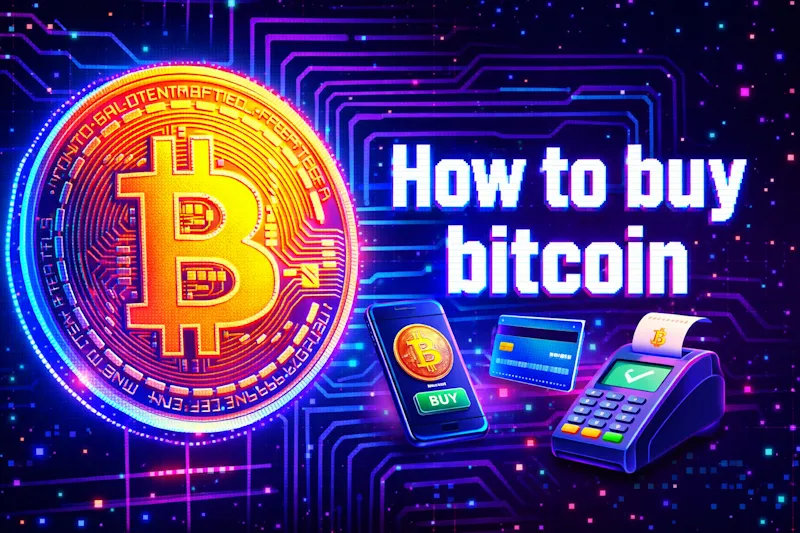
Navigate to the Buy/Sell section. Select Bitcoin (BTC) as the asset you want to purchase. Enter the amount in your local currency — you can buy as little as $10 worth of Bitcoin. Confirm the order and your Bitcoin appears in your exchange wallet within seconds.
MediaCrypto tip: use a limit order instead of a market order when buying larger amounts. A limit order lets you set the exact price you want to buy at — for example placing a limit buy at $76,500 instead of buying at the current $77,000 market price. On large purchases this can save you $50 to $200.
Step 5 — Store Your Bitcoin Safely
Where you store your Bitcoin determines how safe it is. There are two options:
Exchange wallet — your Bitcoin stays on the exchange in their custody. This is fine for amounts under $1,000 and for active traders who buy and sell regularly. The risk is that if the exchange is hacked or goes bankrupt you may lose access to your funds. Always use a regulated exchange like Binance, Coinbase, or Kraken to minimize this risk.
Hardware wallet — a physical device like a Ledger Nano X ($149) or Trezor Model T ($219) that stores your Bitcoin offline in what is called "cold storage." Nobody — not hackers, not governments, not exchange bankruptcies — can access Bitcoin stored in a hardware wallet as long as you keep your recovery seed phrase private. For amounts above $1,000 MediaCrypto recommends moving Bitcoin off exchanges into a hardware wallet.
The most important rule in crypto: never share your seed phrase with anyone. The seed phrase is the 12 or 24 words given to you when you set up your hardware wallet. Anyone with your seed phrase has full access to your Bitcoin. No legitimate exchange, support team, or company will ever ask for it.
Common Bitcoin Buying Mistakes to Avoid in 2026
Buying from social media DMs — if someone contacts you on X, Telegram, WhatsApp, or Instagram offering to sell you Bitcoin, help you invest, or guarantee returns — it is always a scam. 100% of the time. Block and report immediately.
Using unregulated exchanges — stick to Binance, Coinbase, Kraken, or other regulated platforms. Unknown exchanges with no verifiable history have a high probability of being exit scams.
Investing more than you can afford to lose — Bitcoin is volatile. It has dropped 80%+ multiple times in its history. Never invest rent money, emergency funds, or borrowed money in Bitcoin.
Panic selling during corrections — Bitcoin's current correction from $88,000 to $77,000 looks scary. Historically every Bitcoin correction has been followed by a recovery to new all-time highs for long-term holders with patience.
How Much Bitcoin Should a Beginner Buy?
MediaCrypto analysis: most financial advisors suggest keeping crypto exposure between 1% and 5% of your total investment portfolio. For a beginner with $10,000 in savings that means $100 to $500 in Bitcoin. This exposure gives meaningful upside if Bitcoin appreciates while limiting downside to a manageable amount.
Dollar cost averaging — buying a fixed amount of Bitcoin every week or month regardless of price — has historically outperformed lump sum buying for most retail investors. It removes the stress of trying to time the market and smooths out volatility over time.
FAQ — How to Buy Bitcoin in 2026
What is the easiest way to buy Bitcoin in 2026? The easiest way to buy Bitcoin in 2026 is through Coinbase for US users or Binance for international users. Create an account, verify your identity, deposit funds via debit card, and buy BTC in under 10 minutes.
What is the minimum amount of Bitcoin I can buy? Most exchanges allow Bitcoin purchases starting from $10. You do not need to buy a whole Bitcoin — you can buy any fraction, down to 0.00000001 BTC (one satoshi).
Is it safe to buy Bitcoin in 2026? Buying Bitcoin on regulated exchanges like Binance, Coinbase, or Kraken is safe. The risks are price volatility — Bitcoin can drop 30-80% — and security risk if you store Bitcoin on unregulated platforms or share your wallet seed phrase.
What is the best exchange to buy Bitcoin in 2026? MediaCrypto recommends Binance for most international users due to low fees and deep liquidity. For US users Coinbase is the safest regulated option. For security-focused users Kraken is the longest-running exchange with no hack history.
Should I store Bitcoin on an exchange or in a wallet? For amounts under $1,000 keeping Bitcoin on a regulated exchange is acceptable. For amounts above $1,000 MediaCrypto recommends transferring to a hardware wallet like Ledger or Trezor for maximum security.
For live Bitcoin prices and market data see read this article
Read also: Bitcoin Price Prediction July 2026 — read this article
Read also: Strategic Bitcoin Reserve Bill 2026 Explained — read this article
This article is for informational purposes only and does not constitute financial advice. Always do your own research before making investment decisions.